Drive through the brick-lined southwest corner of Greater Woodlawn and you pass a pair of stone entrance pillars marking Woodlawn Circle without giving them a second look. They read as decoration, the kind of aging masonry that just comes with a 1920s neighborhood. Most residents assume the pillars have simply always looked that way, standing guard over the same circular street layout since the land was platted a century ago.
They have not always looked that way. By the mid-1990s those pillars needed real repair, and the money to fix them did not come from the city automatically maintaining a historic asset. It came from a group of neighbors who organized themselves into an association, applied for a municipal grant, and did the work. That single fact says more about how Greater Woodlawn actually functions than any listing description ever will. The neighborhood's small-town feel is not something the area inherited and quietly preserves. It is something a volunteer board rebuilds and reschedules every single year.
The Pillars Needed A Grant Before They Needed Admirers
The Woodlawn Subdivision, the entire southwest quadrant of what's now called Greater Woodlawn, was platted in 1924 by the Consolidated Development and Engineering Corporation. It's the reason the whole area carries the Woodlawn name: the entrance pillars and the circular road layout were distinctive enough to define the identity of everything built around them, even though ten other subdivisions in the surrounding blocks were platted between 1912 and 1950 under different names entirely.
By 1996, those signature pillars had deteriorated to the point that the newly formed Greater Woodlawn Neighborhood Association went looking for help. The city's Neighborhood Partnership Grants Program awarded the association roughly $12,000 that April to rehabilitate the Woodlawn Circle pillars, install identifying signs at the neighborhood's major entrances, and run a membership drive. A year later, GWNA secured another $18,000 to install decorative lighting along 26th Avenue North. Neither project happened because a preservation ordinance required it. Both happened because residents wrote a grant application and did the follow-through.
That distinction matters for anyone who assumes Greater Woodlawn's charm is legally locked in the way it is in some of St. Petersburg's other early-1900s neighborhoods. It isn't. Greater Woodlawn has never held a formal historic district designation. There's no overlay dictating what stays and what goes. The brick streets, the pillars, the lighting along 26th Avenue, all of it survives because people keep choosing to fund and maintain it, one grant application and one volunteer hour at a time.
Eleven Subdivisions, One Half-Square-Mile, One Association Holding It Together
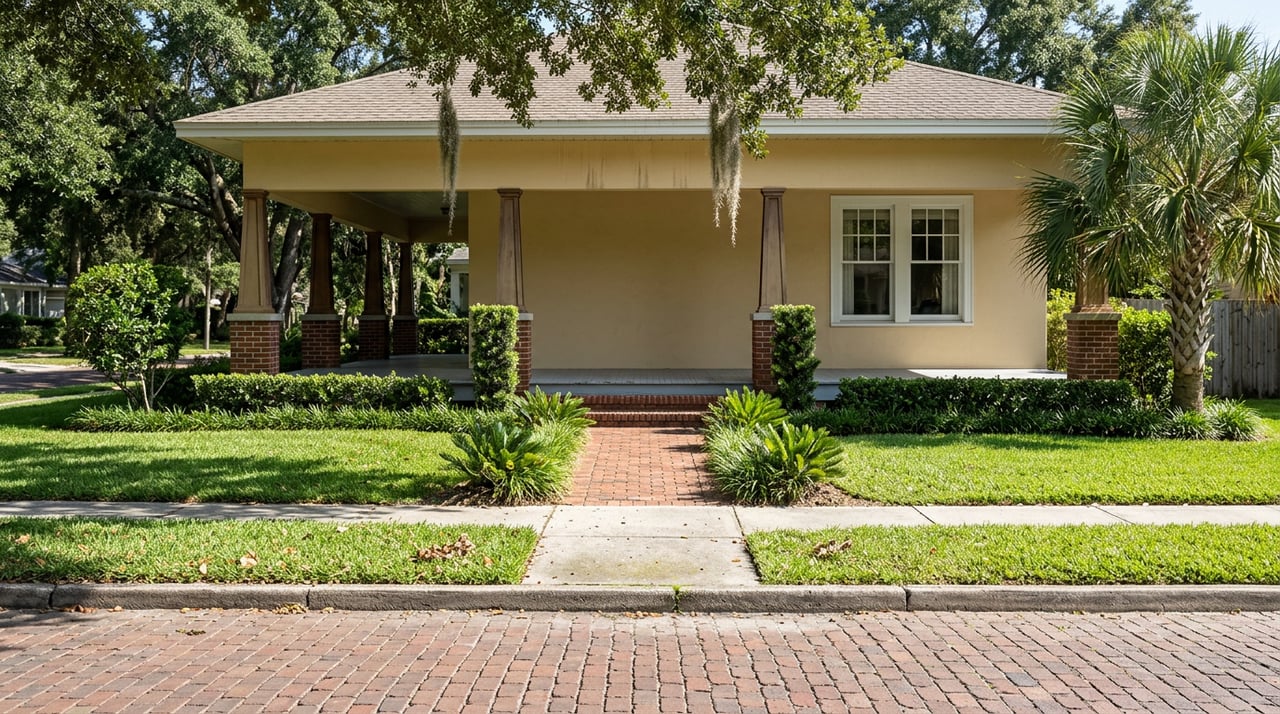
Greater Woodlawn is small on paper, roughly a half square mile bounded by 30th Avenue North, 22nd Avenue North, 16th Street North, and 9th Street North. Inside that boundary sit eleven separate subdivisions platted across four different decades, each with its own history and its own architectural instincts. The Map of Pinellas addition in the northeast quadrant dates to February 1912 and includes a corner park that's now Blanc Park. Washington Heights, in the northwest, was platted in 1914. The Woodlawn Subdivision with its pillars came later, in 1924. Housing stock reflects that patchwork: bungalows and Craftsman cottages dominate most blocks, while the streets directly around Woodlawn Circle tend toward larger, multi-story homes on bigger lots, a visibly different scale within the same half-square-mile footprint.
What stitches eleven subdivisions with different birth years into one recognizable neighborhood is the Greater Woodlawn Neighborhood Association, formed in 1995 and still running on roughly 150 members. GWNA doesn't govern anything. It has no zoning authority and no code enforcement power. What it has is a calendar, a mailing address on Woodlawn Circle West, and a Venmo handle, @GWNA1924, that keeps the whole operation solvent enough to throw a party six or seven times a year.
The Same Handful Of Weekends, Year After Year
Ask a longtime resident what Greater Woodlawn is like and they'll likely describe a rhythm rather than a place: a yard sale in the fall, a Halloween event called Carvin' in the Circle that turns the pillared street into a pumpkin-carving gathering, a Thanksgiving Turkey Trot, an annual Holiday Concert in January, a Cinco de Mayo festival, and porch parties scattered through spring. Summer happy hours land at Golden Isles Brewing Co. Weekly yoga has met at Woodlawn Presbyterian Church, the Mediterranean Revival building on 12th Street North that anchors the neighborhood's northern edge alongside the more contemporary Open Bible Church.
None of that calendar is accidental, and none of it is citywide programming. It's the output of one association's board deciding, meeting by meeting, what the neighborhood does with its weekends. The pattern repeats because the same organization keeps building it:
- Neighborhood Yard Sale, held annually each fall
- Carvin' in the Circle, a Halloween pumpkin event centered on Woodlawn Circle itself
- Thanksgiving Day Turkey Trot
- Annual Holiday Concert
- Cinco de Mayo festival
- Neighborhood Porch Parties, held multiple times through spring
- Summer happy hours at Golden Isles Brewing Co.
- Weekly yoga sessions at Woodlawn Presbyterian Church
Almost every one of those events lands at the same three or four places: Blanc Park, the Circle, or Woodlawn Presbyterian Church. That's not a coincidence either. A half-square-mile neighborhood only has so many gathering spots, and GWNA has spent thirty years routing its calendar through the ones that already exist rather than waiting for new ones to appear.
2024 Turned The Circle's Birthday Into The Whole Neighborhood's Party
The clearest evidence that this is a living, funded operation rather than a nostalgic tradition came in 2024, when GWNA marked one hundred years since the Woodlawn Subdivision was platted with a Centennial Bash built around a 1920s theme, live jazz, an open bar, and grazing boards from a local vendor. Tickets ran $25 for members and $30 for non-members, a small but deliberate gap that rewards the people already paying into the association over the people just showing up for the party.
That pricing detail is easy to skim past, but it's the clearest window into how GWNA actually sustains itself. Membership dues, sponsor support, and modest markups on non-member ticket prices fund the next grant application, the next set of holiday lights, the next round of yard signs. The centennial wasn't a one-off nod to history. It was a fundraising mechanism wearing a party dress, and the calendar it helped fund kept running well past the anniversary year, with GWNA publishing a full slate of dated sessions through the spring of 2026.
The Builders And The Flooring Company Whose Names Show Up At Every Event
Two local businesses recur across GWNA's sponsor list, and both are run by people who live inside the boundary they're sponsoring. Canopy Builders has been constructing homes in St. Petersburg since 2013, and its principal, a Florida native who graduated from St. Pete High School and earned a history degree from the University of Florida, lives in Greater Woodlawn with his wife and sits on the association's board. Floor Coverings International St. Petersburg, celebrating a decade in the city, operates out of a building inside the neighborhood itself.
This isn't outside sponsorship bought at arm's length. It's neighbors who happen to run construction and flooring businesses choosing to underwrite the yard sale flyers and the holiday concert because they're going to attend anyway. It's the same dynamic playing out at a smaller scale in the flags GWNA sells to raise funds, available in house-size 3x2 foot versions or garden-size 12x18 inch versions with canvas headers and brass grommets, a detail so specific it could only come from an organization that actually manages its own inventory.
What The Neighborhood Admits About Itself
GWNA's own materials include a small but telling piece of self-awareness: the association notes that, like any all-volunteer group, there have been stretches where it was more active and stretches where it wasn't, and it expresses relief at having become active again. That's not marketing language. It's an honest acknowledgment that the entire structure this piece has described, the pillars, the calendar, the sponsor list, the centennial, depends on enough residents continuing to volunteer their time. Nothing about it is guaranteed by ordinance or budget line. It runs on whoever shows up to the next meeting.
For anyone who already calls Greater Woodlawn home, that's worth sitting with. The brick streets and the pillared circle read as permanent fixtures, but the community texture layered on top of them, the Turkey Trot, the porch parties, the lights on 26th Avenue, exists only because people kept choosing to fund and staff it for thirty years running. It's a neighborhood that built its own charm rather than simply having good bones and getting out of the way.
Melody Stang has spent years paying attention to exactly this kind of detail across Downtown St. Petersburg and the surrounding waterfront corridor, the parts of a neighborhood's story that never make it into a listing sheet but explain why residents stay. If you're curious how Greater Woodlawn's rhythm compares to a neighborhood you're watching, or you just want to talk through what makes one St. Pete block different from the next, let's connect and schedule a consultation with Melody Stang.