St. Petersburg spent the first months of 2026 telling residents a seawall story. City engineers inspected 81,000 linear feet of shoreline, found more than half of it rated Poor or worse, and unveiled six strategies for fixing what they found. It's the kind of headline that reassures a waterfront buyer: the city is on it.
Here's the part that headline leaves out. If you're looking at a canal lot in Venetian Isles, the wall behind that house almost certainly isn't part of what the city inspected. It's yours. It always has been. And right now, there's no program to help you pay for it.
The Report Everyone Is Reading The Same Way
At a February 10, 2026 public hearing, city officials presented findings from a Strategic Seawall Capital Improvement Plan, an engineering assessment carried out by Cummins Cederberg Coastal and Marine Engineering and funded by a Community Development Block Grant mitigation award of more than $900,000. The number that made news: 53 percent of the seawalls inspected came back rated Poor or worse under American Society of Civil Engineers standards. City staff laid out six response strategies, ranging from straightforward replacement to living shoreline approaches that blend riprap with mangrove plantings, and set a target of finishing a prioritization plan by June 2026.
That's a real number about a real problem. It's also a number about roughly 80,000 linear feet of seawall, and only the feet the city itself owns.
Two Very Different Seawall Systems
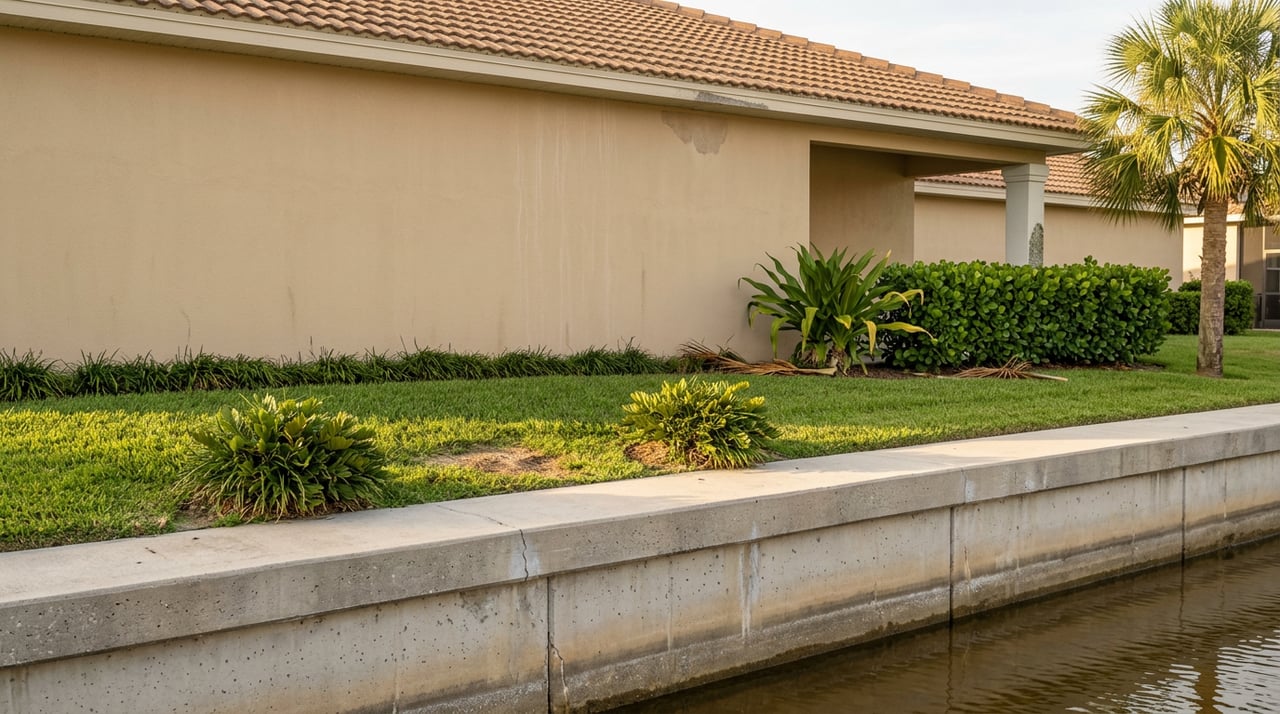
St. Petersburg's own Seawall Master Plan page lays out the split plainly. The city owns about 80,000 linear feet of seawall, roughly 15 miles. Privately owned seawalls run about 500,000 linear feet, close to 95 miles. The public plan, the grant funding, the prioritization schedule, all of it applies to the smaller number.
| Ownership | Approximate Length | Who Pays For Repairs |
|---|---|---|
| City-owned | Funded through the capital improvement plan | |
| Privately owned | The property owner, in full |
A canal community built on private lots sits almost entirely in that second row.
Venetian Isles Was Built By Building Walls
This isn't an abstract distinction in Venetian Isles. It's the reason the neighborhood exists at all. The islands were created in the late 1950s by developer George R. Davis, filled and walled into shape as one of several major waterfront projects he directed along the Suncoast. Florida's governor signed over submerged land rights to the development corporation in 1959, and the price tag for filling that submerged land and building the seawalls to hold it turned out to be steep enough that no homes went up until 1968.
The seawall in Venetian Isles was never an amenity layered onto an existing lot. It's the reason there's dry land to build on in the first place. When a lot line here runs along a canal, the wall holding that line is doing the same job it was built to do in 1968, only decades older.
What One Real Repair Actually Costs
For a sense of what seawall work runs when it goes wrong, look at what happened downtown after Hurricane Milton. A stretch of sidewalk and seawall at the Vinoy Yacht Basin nearly gave way into the bay during the storm and sat as a public safety hazard for weeks. The city council approved a $3.48 million contract to replace it, covering 310 linear feet, a rate that works out to roughly $11,225 per linear foot.
That's a public infrastructure contract, not a residential quote, and material choice, wall height, and site access all move the number for a private homeowner. But it's a useful anchor. It tells you the order of magnitude a failing wall can reach once storm damage forces the issue, rather than a routine repair handled on your own timeline.
The Incentive Program That Doesn't Exist Yet
At that same February 2026 hearing, a resident asked the obvious follow up question: is the city planning to help private owners fund their own repairs? The answer from city staff was direct. There's no such program right now. Officials said they're exploring federal grant opportunities, but nothing exists today that offsets a private seawall repair the way the capital improvement plan funds public ones.
For a Venetian Isles owner, that means the full cost and the full permitting process sit with you. Repairs typically require a permit from the City of St. Petersburg, and if the work touches submerged lands or affects navigable water, the Florida Department of Environmental Protection and the U.S. Army Corps of Engineers can enter the picture too.
The city's seawall plan is real money and real engineering. It's also aimed at 15 miles of wall. Venetian Isles sits inside the other 95.
What This Means If You're Comparing Venetian Isles To Other Waterfront Neighborhoods
If you're weighing Venetian Isles against another canal or bay-front pocket of Tampa Bay, the seawall behind a listing deserves the same scrutiny as the roof or the seawall's own age deserves the same line item as a new HVAC system. A few things worth doing before you write an offer.
Check the city's own condition data first. St. Petersburg maintains an interactive seawall viewer through its Seawall Master Plan page, letting you look up whether a given stretch is publicly or privately owned and see what condition rating it carries. It won't cover every private wall in the same detail as the public inventory, but it's a free first pass before you spend money on a marine survey.
Ask when the wall was last inspected, not just when the house was last renovated. A seawall's structural life and a kitchen's finish life run on completely different clocks, and a fully updated interior tells you nothing about what's holding the yard in place.
Factor in where the code baseline is heading. One of the city's six strategies calls for new seawalls built to a raised elevation of 6.0 feet. A wall that passes inspection today under an older standard may not match the elevation baseline the city is building toward, which matters if you're thinking about eventual replacement costs down the line.
Time your due diligence around the calendar the neighborhood already runs on. The Venetian Isles Homeowners Association's own communications to residents mark June 1 as the start of hurricane season each year and reference lingering effects from recent storms including Helene. A wall with visible stress heading into that window is a different conversation than the same wall in the calm of late winter.
FAQ
Does the city's seawall plan cover my private seawall in Venetian Isles? No. The plan and its funding apply to the roughly 80,000 linear feet of city-owned seawall. A privately owned wall behind a residential canal lot falls outside its scope, and there's currently no city program subsidizing private repairs.
Do I need a permit to repair my own seawall? Yes. Seawall repairs and replacements in St. Petersburg generally require a city permit, and work affecting submerged lands or navigable water can also require review from the Florida Department of Environmental Protection or the U.S. Army Corps of Engineers.
Does seawall condition affect my flood insurance or financing? A seawall helps with erosion but isn't a guaranteed flood protection measure on its own. Flood insurance requirements are driven by FEMA flood zone designation, and lenders or insurers may still ask for condition documentation on a waterfront structure before closing.
Buying on the water in Venetian Isles means buying an asset most people never think to ask about until it's already failing. That's exactly the kind of due diligence a concierge approach is built for, coordinating the marine survey, reading the permit history, and pricing the property with the wall's real condition in view, not just the dock and the view. If you're comparing Venetian Isles to another stretch of Tampa Bay waterfront and want a clear-eyed read on what the premium actually includes, Melody Stang is a call away. Let's connect and schedule a consultation.